Brain Health Snapshot
A short educational questionnaire screening your three core networks — Default Mode, Salience and Central Executive — with a personalised starting protocol.
- No card required
- ~10 minutes
- Personalised protocol emailed
Our approach is built on one principle: brain-health care should begin with looking at the brain. Not a label assembled from a verbal history. Not a guess based on a 15-minute consult. A clinical examination — measured, then interpreted, then translated into a plan you can read.
Heart pain triggers an ECG. Persistent breathlessness triggers spirometry. Joint pain triggers imaging. The matching workup for cognitive, mood, focus, sleep, and recovery complaints — the symptoms produced by the organ at the centre of all of them — is usually a verbal history, a symptom checklist, and a working diagnosis assembled from pattern-recognition.
It isn’t that the technology to do better doesn’t exist. Quantitative EEG has been available for decades. Source-localisation methods like swLORETA have matured to clinical-grade. Normative databases like NeuroGuide are widely deployed. The infrastructure is there.
What hasn’t been built, in most settings, is the workflow that puts the brain into routine cognitive-symptom care — alongside primary medical and psychological treatment, not in place of it. That’s the gap our clinical practice was set up to close.
“A patient who’s spent years being told their symptoms are ‘just stress’ or ‘just anxiety’ or ‘just getting older’ sits differently in a chair the moment they realise we’re going to look. That shift — from being labelled to being examined — is the work itself, before any of the modalities begin.”
— Dr Ash Connell, Head Clinician (Chiropractor, AHPRA registered)
Whatever else changes — the protocols, the technology, the demand — these are the principles the practice runs on.
The brain is the organ. We measure it before we form a plan, with the same plain-language intent any other clinical examination begins from. The qEEG is the entry point of every in-clinic pathway, not an optional extra.
Every modality we use has a peer-reviewed evidence base. We don’t add things because they sound novel. We don’t remove things because they sound traditional. The literature decides what stays in the room.
We are a chiropractic-led brain-health practice. We don’t diagnose neurological or psychiatric conditions, prescribe medication, or replace primary medical care. We refer out when it’s not ours to hold — and we communicate clearly with the practitioners who do hold it.
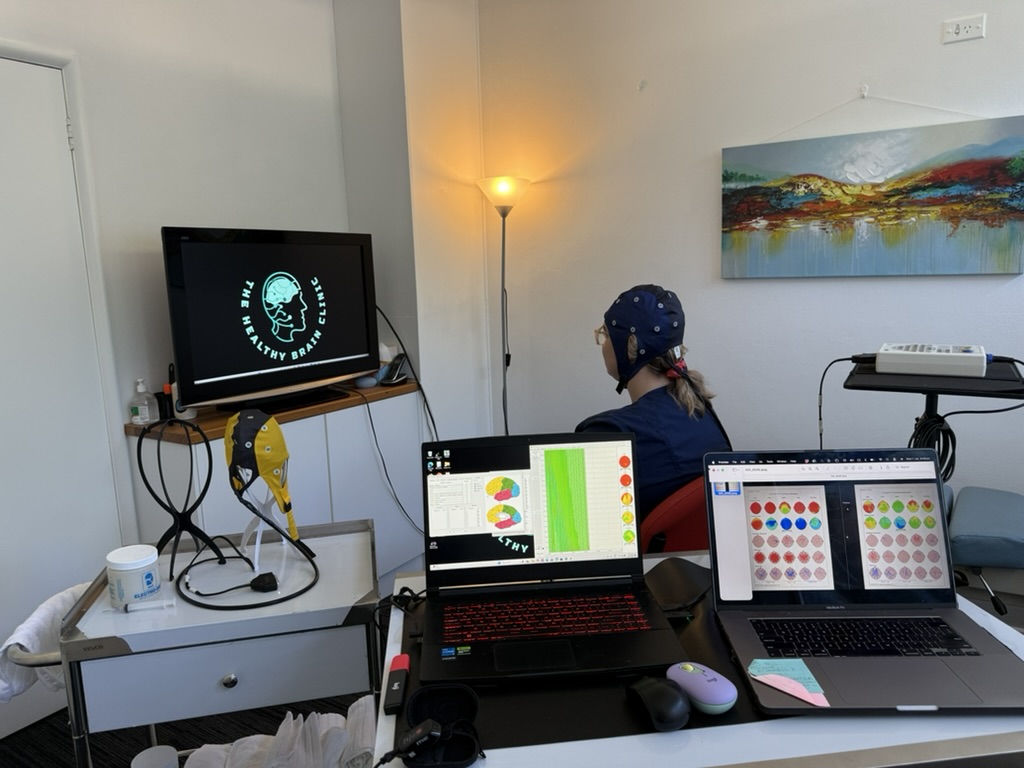
Patients respond differently to a process that begins with looking. We share the qEEG, walk through the findings on screen, and bring you into the formulation — rather than handing it down. Your map is your map.
If a plan is working, we should be able to see it. We re-examine at midpoint and conclusion of every programme. The data tells us — honestly — what to continue, what to change, and what to step away from.
A common pattern in brain-health complaints is that the first thing patients reach for isn’t the lever that moves the symptom. We work in a deliberate order so the levers we eventually use are the ones the picture actually points to.
A measurement-led practice has to be careful with language. We don’t claim to cure, treat, heal, fix, or transform. We don’t promise outcomes. We don’t post patient testimonials as clinical evidence. We don’t share before-and-after brain maps from real patients on this site.
These restraints aren’t reluctant. They’re how we stay honest about what evidence actually supports, and how we comply with the AHPRA advertising guidelines (s133 of the National Law) that govern Australian health practice. Clinical testimonials, even given in good faith, are not what evidence is made of — the variability between individual presentations is too large to draw lessons from one person’s experience.
What we will say is what we measure, what we observe, and what we work toward. The rest, we leave to the picture.
We see ourselves as one contributing input alongside the practitioners already holding your care. With your consent, we communicate in writing — assessment letter, midpoint review, discharge — with your treating GP, psychologist, psychiatrist, sports physician, or neurologist. Our model is collaborative care; we add measurement and a particular set of clinical levers, and the rest of the picture stays in your treating team’s hands.
If you don’t yet have those practitioners, we help you find the right ones — not to widen our funnel, but because brain-health care done in isolation tends to miss things.
We work alongside — not in place of — primary medical and psychological care. We do not diagnose neurological or psychiatric conditions from EEG, and we do not prescribe or alter medication. If you or someone you know is in crisis, call 000 or Lifeline 13 11 14.
The same methodology, every tier
14 brain networks. Quantitative measurement at the start, the middle, and the end. Co-care with your GP and psychologist — we work alongside, not instead of.
19-channel quantitative EEG, processed against age-matched norms via NeuroGuide. swLORETA source localisation maps activity to specific networks.
swLORETA-guided neurofeedback paired with HRV biofeedback at resonant frequency. Network-targeted protocols, not one-size-fits-all.
qEEG comparison at mid-cycle and end of programme. If the data isn’t moving in the expected direction, we change the plan — not the calendar.
One methodology across every tier — from the free Snapshot through to the in-clinic 12-week programme.
Four tiers of care
Every tier uses the same methodology — examination first, then targeted intervention. Choose the depth that fits your concern, your timeline, and your budget.
A short educational questionnaire screening your three core networks — Default Mode, Salience and Central Executive — with a personalised starting protocol.
Full 14-network mapping, 16-region BRLF screening, a 30-day guided programme and content library — 30 days of access.
Real-time HRV biofeedback at home in the NeuroZen app, the full 14-network assessment, a daily 3-minute diary, AI-driven weekly feedback and monthly progress reports.
In-clinic qEEG at the start and again at week 11, a weekly in-clinic visit for 12 weeks, personalised swLORETA neurofeedback, and a clinician-led plan designed by Dr Ash.
All tiers complement, not replace, your GP, psychologist, or psychiatrist. We co-care.
Two ways to begin
Examination, not assumption.
Take the free Brain Health Snapshot to orient yourself, or book a consultation with Dr Ash Connell. Both are easy to step away from, and either way you’ll leave with a clearer picture of what’s actually going on.
Or call (03) 5593 2934 — reception will take a few details and call you back within one business day.