The full list of presentations we examine.
What people bring to us tends to share something in common — patterns of brain activity that have shifted out of balance. The patterns underneath the labels, in clinic shorthand. Six functional domains, mapped on a qEEG, worked with through five non-invasive modalities.
We organise our work by function, not just by diagnosis.
Behind most named conditions lies the same set of brain-network patterns — under-arousal, over-arousal, poor connectivity between regions, dysrhythmia. Mapping the function lets us build a clinical plan that fits the person, not just the label.
Mood & emotional regulation
Patterns of arousal and frontal-cortex regulation that show up across anxiety, depression, and trauma-related stress.
- Anxiety
- Depression
- PTSD
Focus & attention
Attention-network signatures and executive-function patterns — the brain rhythms behind sustained focus, switching, and follow-through.
- ADHD
- Executive function
Memory & cognitive change
Brain fog, slowed processing, and changes in memory or word-finding — assessed in the context of sleep, mood, and history.
- Brain fog
- Cognitive change
- Post-concussion
Recovery & resilience
After concussion, traumatic brain injury, or a stretch of chronic stress and burnout — the work of helping the nervous system come back online.
- Concussion
- Traumatic brain injury
- Stress & burnout
Learning & processing
An adjunct — never a substitute — for speech pathology, audiology, and structured-literacy work in children and adults whose learning is harder than it should be.
- Auditory processing
- Dyslexia
- Learning difficulties
Sleep & arousal regulation
Sleep cuts across every other domain. We work with the brain rhythms behind falling asleep, staying asleep, and waking rested — and with the hyperarousal that gets in the way.
- Sleep difficulties
- Hyperarousal
- Settling
If your concern isn't listed, we'd still encourage you to get in touch. Many of the patterns we see don't fit neatly into a single label.
A measurement, not a verdict.
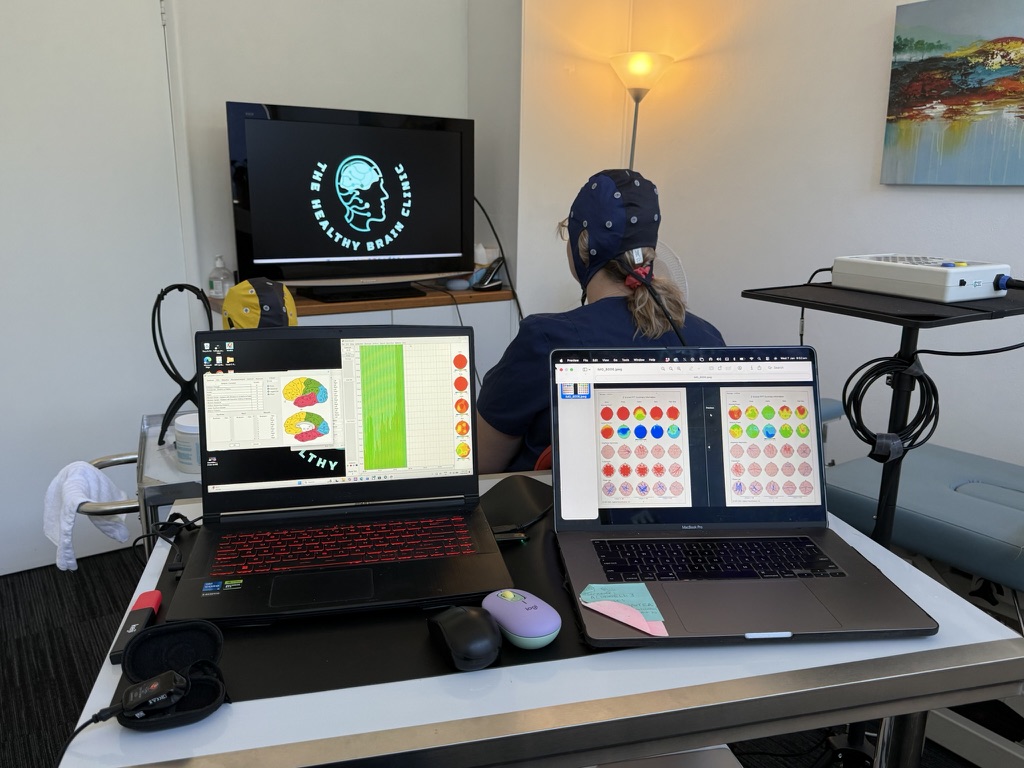
A quantitative EEG (qEEG) records the brain's electrical rhythms across 19 sites and compares them to a normative database. It's non-invasive, comfortable to sit through, and takes about 20 minutes.
What it gives us is a structured picture of how the brain is regulating attention, arousal, and connectivity. What it doesn't do is diagnose any single condition. It's information — used alongside the conversation, the history, and any assessments your other clinicians have done.
Read more about qEEGWhat qEEG can do
- Map brainwave patterns across 19 cortical sites
- Compare your patterns to age-matched norms
- Highlight network-level connectivity
- Inform individualised neurofeedback parameters
- Track change over a course of training
What qEEG cannot do
- Diagnose any specific condition on its own
- Replace neurological imaging or a GP work-up
- Predict your response to medication
- Substitute for assessment by a psychologist, audiologist, or speech pathologist
- Guarantee any clinical outcome
Conditions A–Z
Browse by name.
If you'd rather start from the label you know, here's the full A–Z. Each one takes you to the part of the site that fits it best.
Not navigating a clinical concern?
The same brain mapping and self-regulation work also applies to peak performance, performance anxiety, executive function for high-demand work, and cognitive ageing well. We have a separate hub for that.
Scope of practice. Dr Ash Connell (Chiropractor) is registered with AHPRA. Clinical services at The Healthy Brain Clinic are delivered under additional certifications in qEEG, neurofeedback, and biofeedback. We work alongside — not instead of — your GP, psychologist, or psychiatrist, and we refer when clinically appropriate.
If you need urgent support, contact your GP, call Lifeline on 13 11 14, or in an emergency call 000.