Brain Health Snapshot
A short educational questionnaire screening your three core networks — Default Mode, Salience and Central Executive — with a personalised starting protocol.
- No card required
- ~10 minutes
- Personalised protocol emailed
The Healthy Brain Method is the three-stage frame that runs through every programme at the clinic. It’s not branding. It’s the actual sequence of clinical reasoning we use — from your first qEEG to the last week of your programme — and the philosophy that decides what we put in, what we leave out, and how we know whether the work is moving.
Most brain-health complaints fail at the first stage — the brain itself never gets looked at. The Healthy Brain Method makes the looking the entry point of the work, not an optional add-on. Once we’ve seen, we have something to understand. Once we understand, we have something specific and personal to work with.
Below are the three stages in plain language, exactly as they unfold across a typical 12-week programme.
Examination, not assumption. The brain itself becomes part of the workup.
Most brain-health workups begin with a verbal symptom report and a working diagnosis assembled from pattern-recognition. Useful as far as it goes — but the organ at the centre of the picture has stayed off the table.
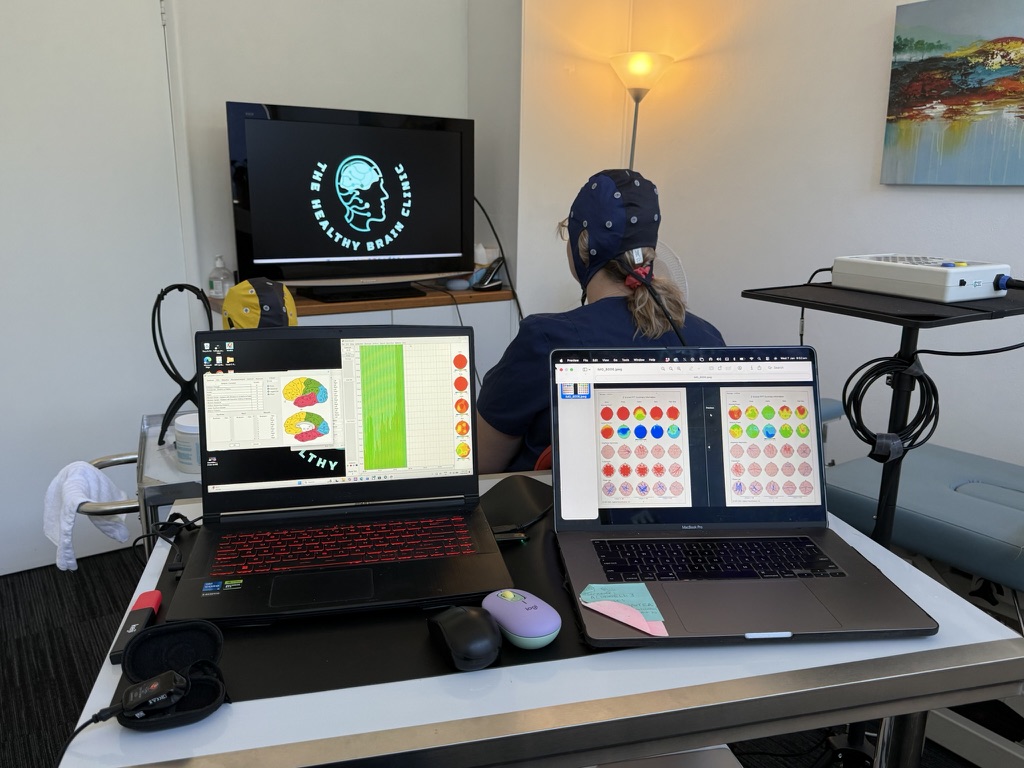
Stage 1 puts it on the table. A 19-channel quantitative EEG, recorded at rest and during cognitive task. swLORETA source-localisation where the picture warrants depth. Autonomic markers — HRV, respiration, electrodermal — for what the cortex alone can’t tell us. A structured intake covering medical, psychological, sleep, lifestyle, and cognitive history. Validated questionnaires.
By the end of Stage 1, you have been looked at as a brain — not as a list of symptoms, not as a diagnosis-by-default, not as a 15-minute consult. The data exists. The picture is real.
Findings on their own aren’t a clinical picture. Integration is the work.
The output of Stage 1 is data. The work of Stage 2 is integration — placing the qEEG findings into context with the intake history, the autonomic data, and the questionnaires, and asking what story the inputs tell when read together.
The output is a written formulation. Your referring practitioner receives it as a letter, with consent. You receive it as a sit-down conversation with Dr Ash — walking through the report on a screen, in plain language, with enough time to actually understand it.
We don’t hand the formulation down. We bring you into it. Your map is your map.
By the end of Stage 2, you know what’s been measured, what it means, what’s been ruled in, what’s been ruled out, and what we’re proposing next. The picture is shared, not handed down.
A personalised programme, designed by Dr Ash from your actual data.
The plan is not a template. It’s built from your qEEG findings, your autonomic profile, your intake history, your goals, and your life context — weighted toward the modalities most likely to move what the picture shows.
For most patients, the in-clinic pathway is the 12-Week Healthy Brain Programme — weekly swLORETA-guided neurofeedback sessions sequenced to your cortical signature, integrated HRV biofeedback for autonomic regulation, functional neurological exercises calibrated to vestibular and ocular-motor findings, and neuro-nutrition input where intake history points there. The Tier 2 portal runs alongside from day one — the Daily Diary engine watches between sessions, so we walk into every appointment with last week’s behavioural data already on screen.
At Week 11, we re-image. The Week 12 review is a side-by-side: your initial brain map next to your follow-up brain map, with the diary data layered alongside. The conversation that follows is honest. If the picture has moved, we say so. If it hasn’t, we say that too — and we revisit the formulation together.
By the end of Stage 3, you have a measured before-and-after, a clear picture of what changed, a recommendation for what comes next — and the data to evaluate it honestly.
Three things make this method different from typical brain-health offerings:
We don’t guess. We measure — and we keep measuring.
We work alongside — not in place of — primary medical and psychological care. We do not diagnose neurological or psychiatric conditions from EEG, and we do not prescribe or alter medication. If you or someone you know is in crisis, call 000 or Lifeline 13 11 14.
The same methodology, every tier
14 brain networks. Quantitative measurement at the start, the middle, and the end. Co-care with your GP and psychologist — we work alongside, not instead of.
19-channel quantitative EEG, processed against age-matched norms via NeuroGuide. swLORETA source localisation maps activity to specific networks.
swLORETA-guided neurofeedback paired with HRV biofeedback at resonant frequency. Network-targeted protocols, not one-size-fits-all.
qEEG comparison at mid-cycle and end of programme. If the data isn’t moving in the expected direction, we change the plan — not the calendar.
One methodology across every tier — from the free Snapshot through to the in-clinic 12-week programme.
Four tiers of care
Every tier uses the same methodology — examination first, then targeted intervention. Choose the depth that fits your concern, your timeline, and your budget.
A short educational questionnaire screening your three core networks — Default Mode, Salience and Central Executive — with a personalised starting protocol.
Full 14-network mapping, 16-region BRLF screening, a 30-day guided programme and content library — 30 days of access.
Real-time HRV biofeedback at home in the NeuroZen app, the full 14-network assessment, a daily 3-minute diary, AI-driven weekly feedback and monthly progress reports.
In-clinic qEEG at the start and again at week 11, a weekly in-clinic visit for 12 weeks, personalised swLORETA neurofeedback, and a clinician-led plan designed by Dr Ash.
All tiers complement, not replace, your GP, psychologist, or psychiatrist. We co-care.
Two ways to begin
Examination, not assumption.
Take the free Brain Health Snapshot to orient yourself, or book a consultation with Dr Ash Connell. Both are easy to step away from, and either way you’ll leave with a clearer picture of what’s actually going on.
Or call (03) 5593 2934 — reception will take a few details and call you back within one business day.