What to wear
Comfortable, loose-fitting clothing. The qEEG cap goes on the top of your head, so high-collared tops or jewellery near the ears can get in the way. Hair tied loosely is fine.
An honest walkthrough of what happens before, during, and after your first appointment — so you can prepare well, and arrive without the usual first-visit nerves.
A few small things — done in the days and hours before your visit — make a real difference to the recording, and to the conversation.
Both forms arrive by email once you book. Filling them in beforehand means we spend the session on your story — not on paperwork.
If you're on medication that affects brain function (stimulants, SSRIs, benzodiazepines, anti-epileptics, sleep medication, etc.), don't change anything without speaking to your prescribing doctor first. For short-acting medication (e.g. stimulants taken in the morning), your prescriber may suggest the appointment is timed around your dose. For long-acting medication, we record on your normal regimen — that's actually what we want to see. Call reception with any questions before adjusting anything.
Comfortable, loose-fitting clothing. The qEEG cap goes on the top of your head, so high-collared tops or jewellery near the ears can get in the way. Hair tied loosely is fine.
A list of any current medications and supplements, recent pathology results if you have them, and any prior brain imaging or EEG reports. None of it is required — it just sharpens the conversation.
Towels for cleaning the conductive gel out of your hair after the recording, water, tissues, and a private restroom if you'd like to freshen up before leaving.
The session is mentally light — no driving restriction — but most people prefer to go home rather than back to high-load work. The conversation often surfaces things worth sitting with for an hour.
First appointments run 45–60 minutes, depending on whether you're doing the qEEG on the day. Here's how it actually unfolds.
Reception greets you, confirms your details, and walks you through to a quiet consulting room. Restroom access if you need it. We take a few minutes to settle in and review your intake form together — there are usually one or two things worth clarifying before we start.
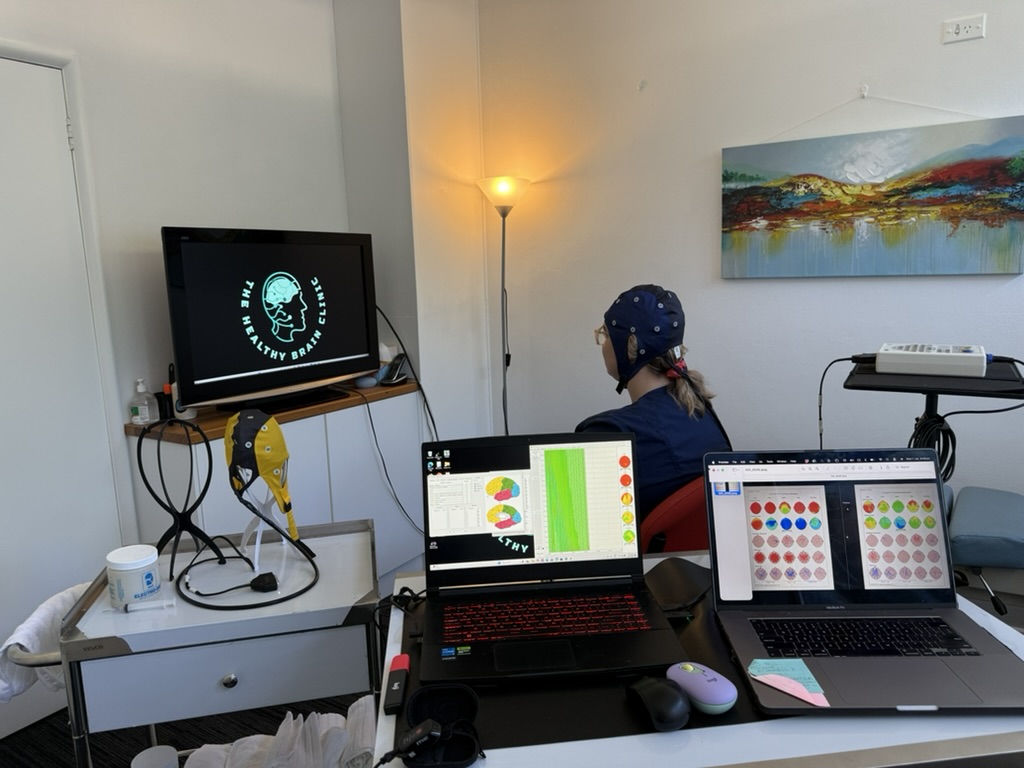
If today is your qEEG day, we measure your head, fit a soft elastic cap with 19 silver electrodes positioned at standardised sites, and apply a small amount of conductive gel at each electrode (this washes out easily — we provide towels). The cap is comfortable, similar to a swim cap. The recording itself is 20 minutes total.
During the recording you'll be asked to:
Nothing is being put into your brain. The cap is recording your brain's own electrical activity — same principle as an ECG, but for the cortex rather than the heart.
A small finger sensor records your heart rate, skin conductance, temperature, and breathing pattern. We may include a short stress test — a simple arithmetic task or word challenge — to see how your autonomic system responds to cognitive load. Tells us how well your nervous system recovers between effortful moments.
The cap comes off in under a minute. Towels and a private space to clean up if you'd like — the gel is water-soluble and rinses out easily at home.
Dr Ash reviews the session findings with you and gives an overview of what stood out — what's clearly within normative range, what's worth examining further, and what the next step looks like. The full written report follows your review appointment in Week 2.
We don't run standalone qEEG appointments. The first appointment is the data-collection session; the second appointment, in Week 2, is the review — where Dr Ash sits with you, walks through the full processed report on screen, and explains what each finding means in plain language.
By the end of the review appointment, you'll have:
If your appointment is by referral from a third-party clinician (psychologist, psychiatrist, paediatrician, neurologist) and they need raw qEEG data only, we can run the data-collection appointment as a stand-alone — they receive the raw recording and reports, and your follow-up sits with them. For all other patients, the review appointment is part of the package.
If the picture warrants ongoing care, our standard in-clinic pathway is a 12-week programme — designed to nudge the brain back in the right direction.
The 12-week programme is a starting point — it's designed to get your brain working in the right direction. At Week 12 we evaluate together: some patients continue to improve on their own from there; others benefit from longer ongoing care. If you continue, the price stays at $175 per weekly swLORETA neurofeedback session for as long as the work is making measurable progress.
No referral required. Claimable through some health funds, Medicare Care Plans, and self-managed NDIS — call reception to confirm cover for your specific situation.
No. The cap is comfortable. The conductive gel is room-temperature and rinses out with water. Nothing is being put into your brain — we are only recording the electrical activity it's producing on its own.
No referral is required. You're welcome to book directly. We'll encourage you to stay connected with your GP and any other treating clinicians, and we coordinate with them where it's helpful.
Some health funds cover sessions through their extras (chiropractic). Medicare Care Plans and self-managed NDIS plans may apply for some patients. Cover varies by fund and plan — call reception with your specific details and we'll confirm before you commit.
Tell us when you arrive. If you've had your usual coffee, the recording will reflect a slightly more activated baseline — we factor that in. If you've had significantly more than normal, we may suggest rescheduling so the recording reflects your typical brain rather than a stimulated one.
Yes — we welcome a partner, parent, or support person at any appointment, particularly the review when there's a lot of information to take in. Just tell reception when you book so we can plan the room.
It's a common concern. The cap is light and removable at any moment. Patients are welcome to take breaks, stop, or reschedule if anything feels uncomfortable. We've fitted caps on hundreds of nervous first-timers — the typical experience is "much less of a thing than I was expecting."
We work alongside — not in place of — primary medical and psychological care. We do not diagnose neurological or psychiatric conditions from EEG, and we do not prescribe or alter medication. If you or someone you know is in crisis, call 000 or Lifeline 13 11 14.
The same methodology, every tier
14 brain networks. Quantitative measurement at the start, the middle, and the end. Co-care with your GP and psychologist — we work alongside, not instead of.
19-channel quantitative EEG, processed against age-matched norms via NeuroGuide. swLORETA source localisation maps activity to specific networks.
swLORETA-guided neurofeedback paired with HRV biofeedback at resonant frequency. Network-targeted protocols, not one-size-fits-all.
qEEG comparison at mid-cycle and end of programme. If the data isn’t moving in the expected direction, we change the plan — not the calendar.
One methodology across every tier — from the free Snapshot through to the in-clinic 12-week programme.
Four tiers of care
Every tier uses the same methodology — examination first, then targeted intervention. Choose the depth that fits your concern, your timeline, and your budget.
A short educational questionnaire screening your three core networks — Default Mode, Salience and Central Executive — with a personalised starting protocol.
Full 14-network mapping, 16-region BRLF screening, a 30-day guided programme and content library — 30 days of access.
Real-time HRV biofeedback at home in the NeuroZen app, the full 14-network assessment, a daily 3-minute diary, AI-driven weekly feedback and monthly progress reports.
In-clinic qEEG at the start and again at week 11, a weekly in-clinic visit for 12 weeks, personalised swLORETA neurofeedback, and a clinician-led plan designed by Dr Ash.
All tiers complement, not replace, your GP, psychologist, or psychiatrist. We co-care.
Two ways to begin
Examination, not assumption.
Take the free Brain Health Snapshot to orient yourself, or book a consultation with Dr Ash Connell. Both are easy to step away from, and either way you’ll leave with a clearer picture of what’s actually going on.
Or call (03) 5593 2934 — reception will take a few details and call you back within one business day.