Brain Health Snapshot
A short educational questionnaire screening your three core networks — Default Mode, Salience and Central Executive — with a personalised starting protocol.
- No card required
- ~10 minutes
- Personalised protocol emailed
For patients recovering from moderate-to-severe TBI, our work runs strictly alongside your neurology, rehabilitation medicine, and allied-health team. We add measurement-led training; we do not replace primary care.
This page is for patients who have completed acute care for a moderate or severe traumatic brain injury, are under the care of a treating neurologist or rehabilitation physician, and are looking for measurement-led adjunct work — typically through a referral from their treating team.
If your injury was a concussion or mild TBI, the pathway you want is concussion & post-concussion symptoms.
For TBI patients, we work as an adjunct to the rehabilitation team that is already in place. The qEEG can identify cortical dysregulation that informs neurofeedback or biofeedback work. Functional neurological exercises can complement physiotherapy, occupational therapy, and vestibular rehabilitation. Mind-body and autonomic-regulation work can support recovery of sleep architecture and emotional regulation.
We coordinate with your treating team in writing — assessment letter, midpoint review, discharge — and refer back when the picture warrants.
We work alongside — not in place of — primary medical and psychological care. We do not diagnose neurological or psychiatric conditions from EEG, and we do not prescribe or alter medication. If you or someone you know is in crisis, call 000 or Lifeline 13 11 14.
The same methodology, every tier
14 brain networks. Quantitative measurement at the start, the middle, and the end. Co-care with your GP and psychologist — we work alongside, not instead of.
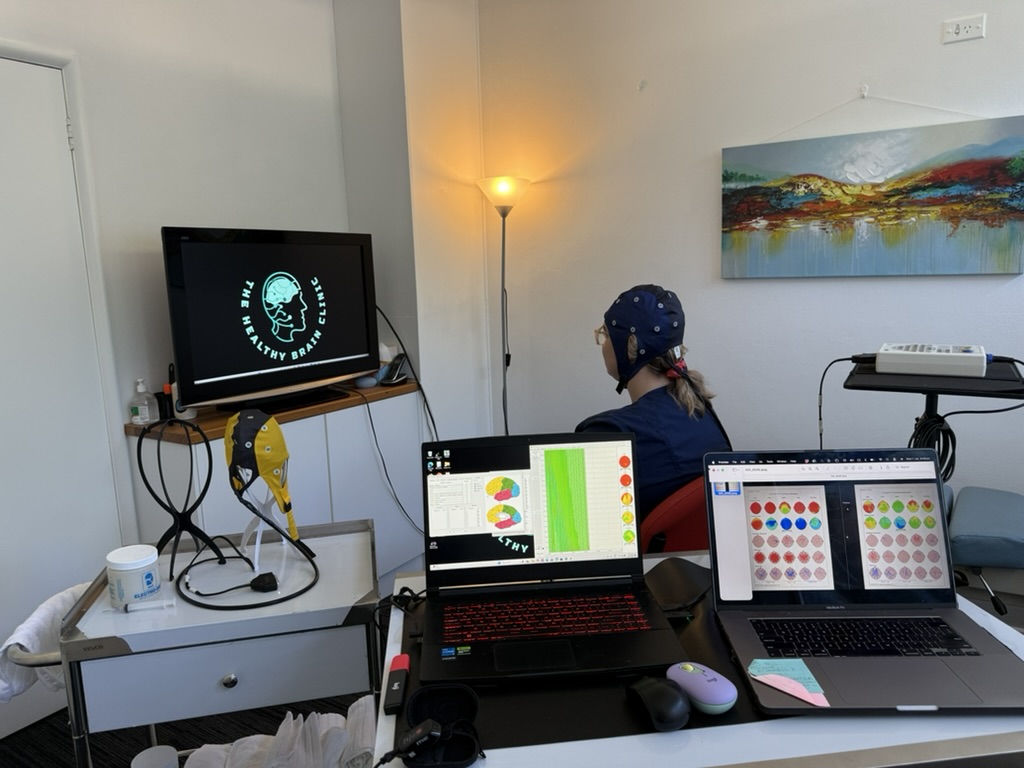
19-channel quantitative EEG, processed against age-matched norms via NeuroGuide. swLORETA source localisation maps activity to specific networks.
swLORETA-guided neurofeedback paired with HRV biofeedback at resonant frequency. Network-targeted protocols, not one-size-fits-all.
qEEG comparison at mid-cycle and end of programme. If the data isn’t moving in the expected direction, we change the plan — not the calendar.
One methodology across every tier — from the free Snapshot through to the in-clinic 12-week programme.
Four tiers of care
Every tier uses the same methodology — examination first, then targeted intervention. Choose the depth that fits your concern, your timeline, and your budget.
A short educational questionnaire screening your three core networks — Default Mode, Salience and Central Executive — with a personalised starting protocol.
Full 14-network mapping, 16-region BRLF screening, a 30-day guided programme and content library — 30 days of access.
Real-time HRV biofeedback at home in the NeuroZen app, the full 14-network assessment, a daily 3-minute diary, AI-driven weekly feedback and monthly progress reports.
In-clinic qEEG at the start and again at week 11, a weekly in-clinic visit for 12 weeks, personalised swLORETA neurofeedback, and a clinician-led plan designed by Dr Ash.
All tiers complement, not replace, your GP, psychologist, or psychiatrist. We co-care.
Two ways to begin
Examination, not assumption.
Take the free Brain Health Snapshot to orient yourself, or book a consultation with Dr Ash Connell. Both are easy to step away from, and either way you’ll leave with a clearer picture of what’s actually going on.
Or call (03) 5593 2934 — reception will take a few details and call you back within one business day.